Reduce reactor optimization from months to days.
Experimental flow measurement to validate, enhance, and accelerate CFD-driven optimization. Evaluate 10+ configurations in under a week and pick the best design with confidence.
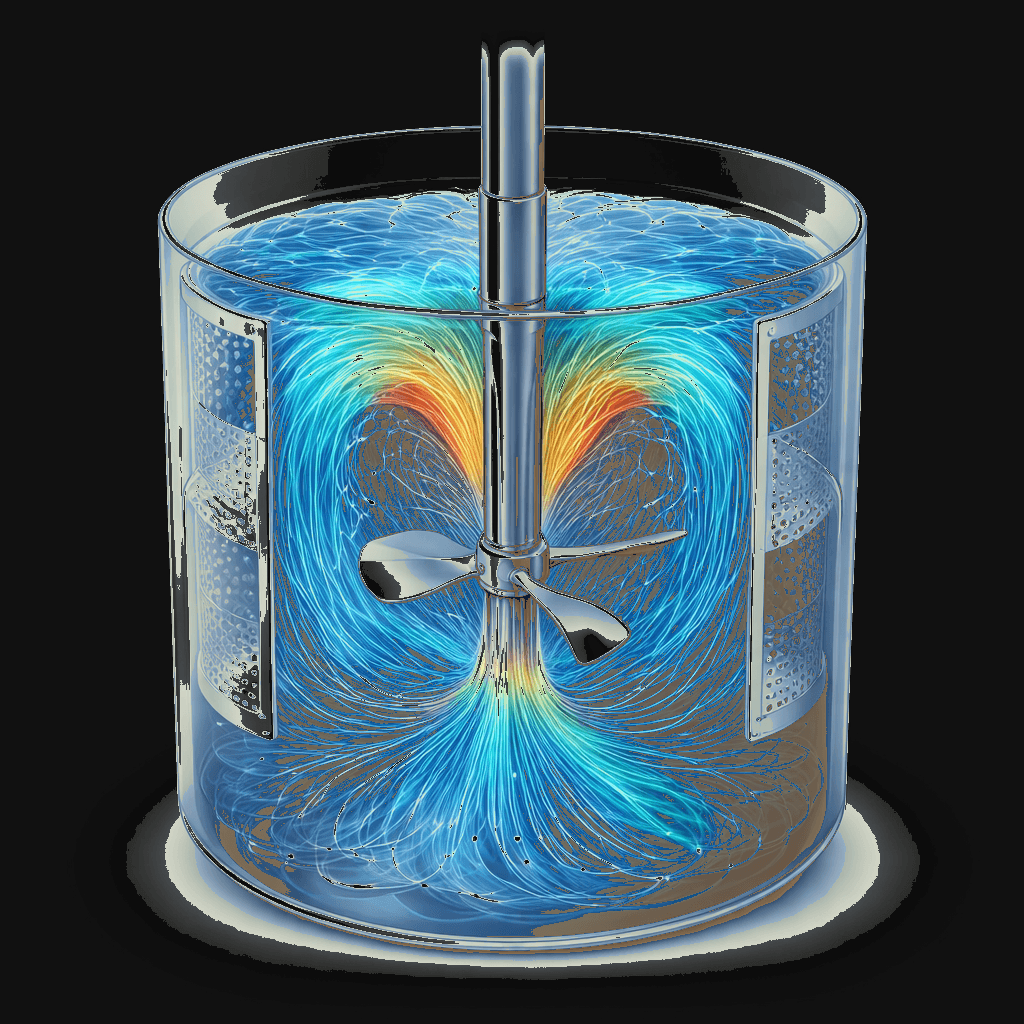
What this means in practice
Instead of narrowing to a few designs early, you can explore the full design space quickly then lock the decision with measured evidence. Your CFD becomes trustworthy. Your pilot scope shrinks. Your time-to-market compresses.
Radioactive tracer follows the flow. Detectors capture 3D trajectories. AI reconstructs full fields from measured data, no turbulence-model guessing.
Identify dead zones, recirculation patterns, mixing efficiency vs power, and turbulence metrics so you can choose the best configuration with confidence.
Mixing equipment manufacturer
A manufacturer needed the optimal impeller configuration for a viscous slurry application but could not afford to test more than 3 designs with traditional pilot methods.
10 configurations evaluated (vs. 3 with traditional methods). Total campaign duration: 4 days.
Evaluate 10x more designs in a fraction of the time
Calibration is a one-time cost. Once calibrated, additional configurations are tested rapidly, enabling design space optimization impossible with pilot testing alone.
Who uses Fluidmapper
Four buyer types. One platform. Each gets measurable, decision-ready flow intelligence in days.
Optimize agitators, mixers, and reactors. Screen 10+ impeller designs in days.
De-risk reactor selection and scale-up. Measured flow data before committing to capital.
Validate simulation codes against measured data. Improve closure equations.
Publication-ready datasets with full uncertainty quantification.
From geometry to measured flow intelligence in 4 steps
Measured physics first. AI extends the measurement. This is not CFD.
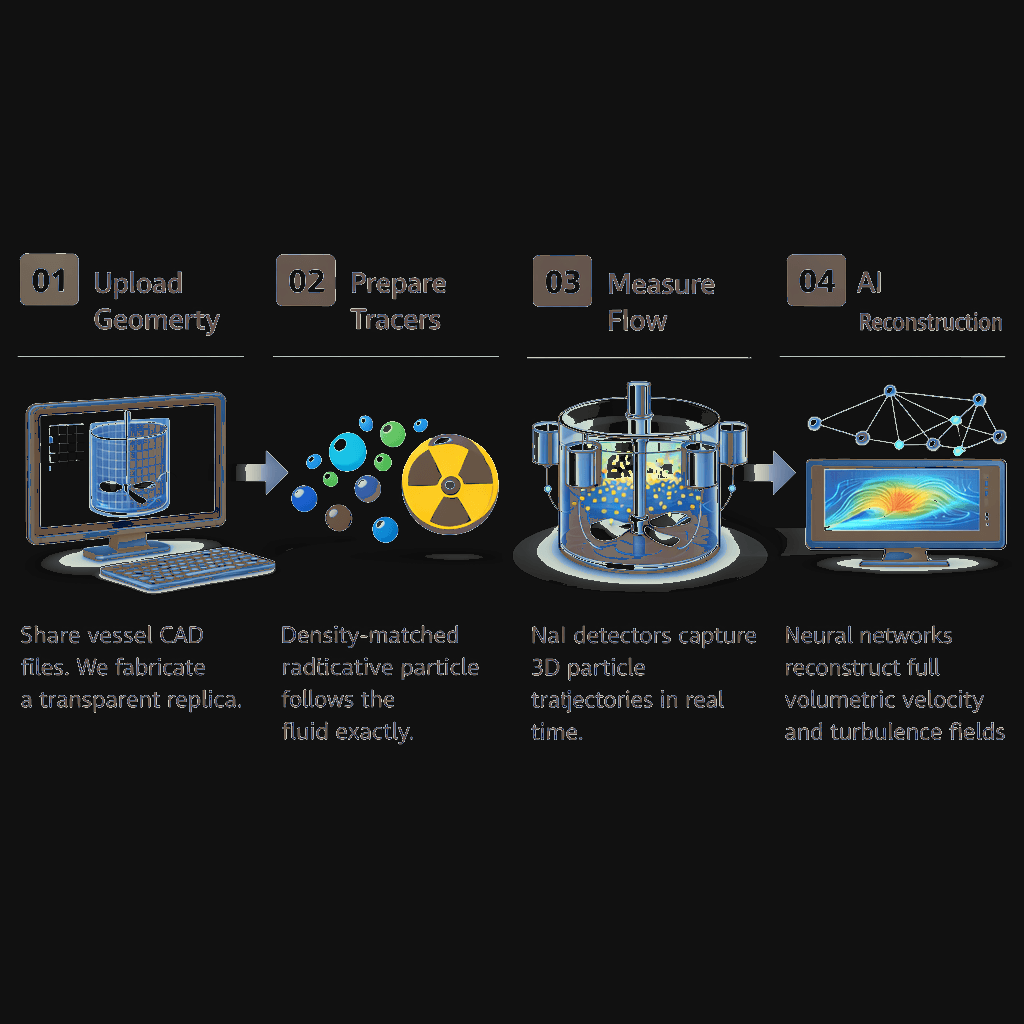
Share CAD + operating conditions. We fabricate a transparent replica.
Density-matched radioactive tracer follows the fluid exactly.
NaI detectors capture real-time 3D particle trajectories.
Neural models reconstruct full volumetric velocity + turbulence fields from measured data.
Deliverables teams actually use
You don't just get plots. You get quantified performance curves and ground-truth fields your team can compare directly against CFD and use to select designs.
- Full 3D velocity fields (axial, radial, tangential)
- Dead-zone mapping + recirculation identification
- Mixing efficiency vs power curves across configurations
- Turbulence metrics (TKE, Reynolds stresses, dissipation)
- CFD validation datasets formatted for direct comparison
- Quantitative data with defined measurement uncertainty bounds
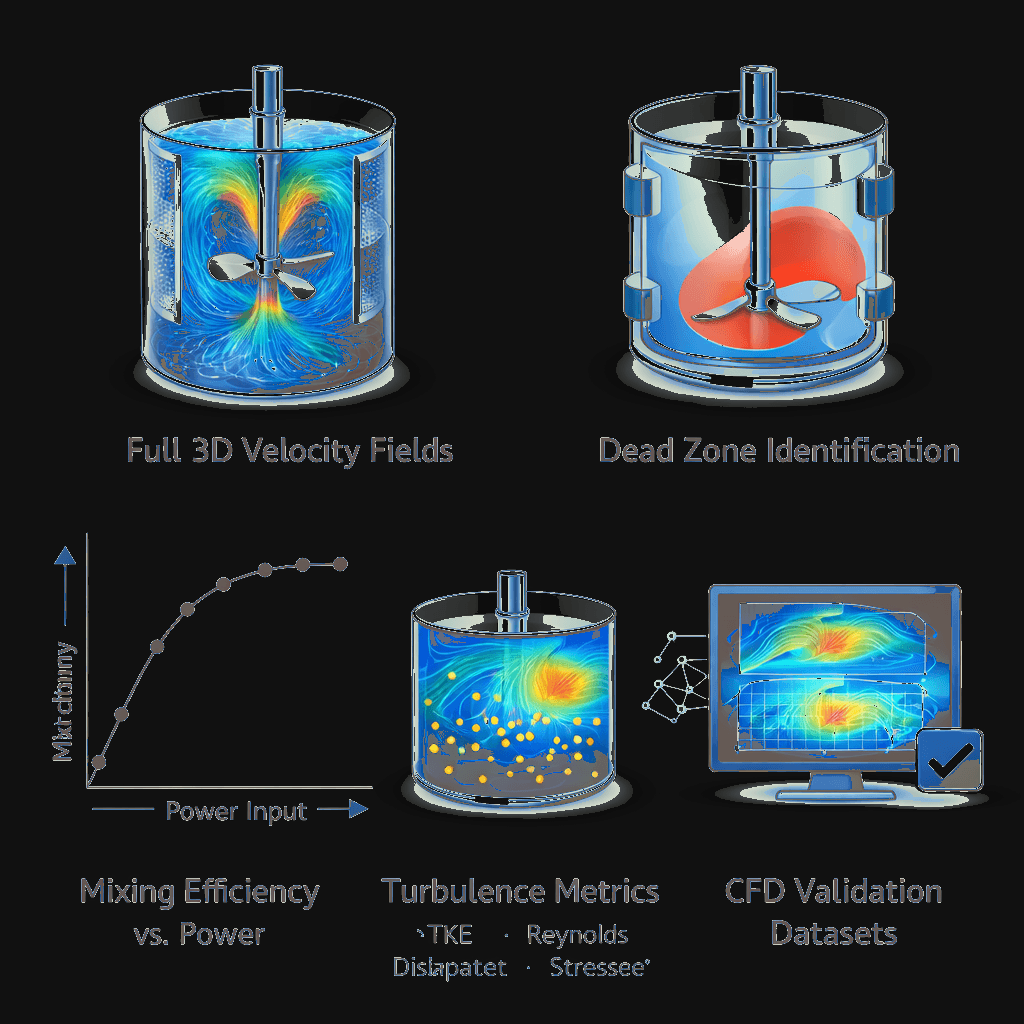
Full volumetric velocity fields with axial, radial, and tangential components across the entire vessel.
Performance curves across all tested configurations for direct design comparison and selection.
Identify and quantify stagnant regions to optimize flow coverage and reduce process variability.
TKE, Reynolds stresses, and energy dissipation rates for engineering analysis and CFD validation.
Stop guessing. Start measuring.
Book a 30-minute technical assessment. We'll review your geometry and operating conditions and return a fixed-price proposal within 48 hours.